
Ready to take the TCI Assessment?
In just 2 minutes, you'll:
- Benchmark your investment approach against 1,000 global organizations we surveyed
- Identify your current TCI maturity level
- Unlock tailored recommendations for resilient tech investments
Use the slider scale to rate how much consideration is given to each value and risk area before technology investment decisions are made.
How does your organization compare?
Questions 1-5
Assess how technology will create or erode long-term value.When making technology investment decisions, how much consideration do you give to the impact across the following areas?
1 = Not considered / 10 = Fully embedded in decision-making
Questions 1-5
Assess how technology will create or erode long-term value.When making technology investment decisions, how much consideration do you give to the impact across the following areas?
1 = Not considered / 10 = Fully embedded in decision-making
Questions 1-5
Assess how technology will create or erode long-term value.When making technology investment decisions, how much consideration do you give to the impact across the following areas?
1 = Not considered / 10 = Fully embedded in decision-making
Questions 1-5
Assess how technology will create or erode long-term value.When making technology investment decisions, how much consideration do you give to the impact across the following areas?
1 = Not considered / 10 = Fully embedded in decision-making
Questions 6-10
Assess how technology will introduce or mitigate lifecycle risks.When making technology investment decisions, how thoroughly do you evaluate risks across the following areas?
1 = Not assessed / 10 = Systematically assessed and factored into decisions
Questions 6-10
Assess how technology will introduce or mitigate lifecycle risks.When making technology investment decisions, how thoroughly do you evaluate risks across the following areas?
1 = Not assessed / 10 = Systematically assessed and factored into decisions
Questions 6-10
Assess how technology will introduce or mitigate lifecycle risks.When making technology investment decisions, how thoroughly do you evaluate risks across the following areas?
1 = Not assessed / 10 = Systematically assessed and factored into decisions
Questions 6-10
Assess how technology will introduce or mitigate lifecycle risks.When making technology investment decisions, how thoroughly do you evaluate risks across the following areas?
1 = Not assessed / 10 = Systematically assessed and factored into decisions
Questions 6-10
Assess how technology will introduce or mitigate lifecycle risks.When making technology investment decisions, how thoroughly do you evaluate risks across the following areas?
1 = Not assessed / 10 = Systematically assessed and factored into decisions
Questions 6-10
Assess how technology will introduce or mitigate lifecycle risks.When making technology investment decisions, how thoroughly do you evaluate risks across the following areas?
1 = Not assessed / 10 = Systematically assessed and factored into decisions
Your approach to technology decisions
You scored 00 for value and 00 for risk - placing you in the [quadrent name] quadrant.
1. Cost-led
Congratulations! You’ve taken the first step toward optimizing the value your technology creates across its lifecycle. After all, you cannot manage what you cannot measure.
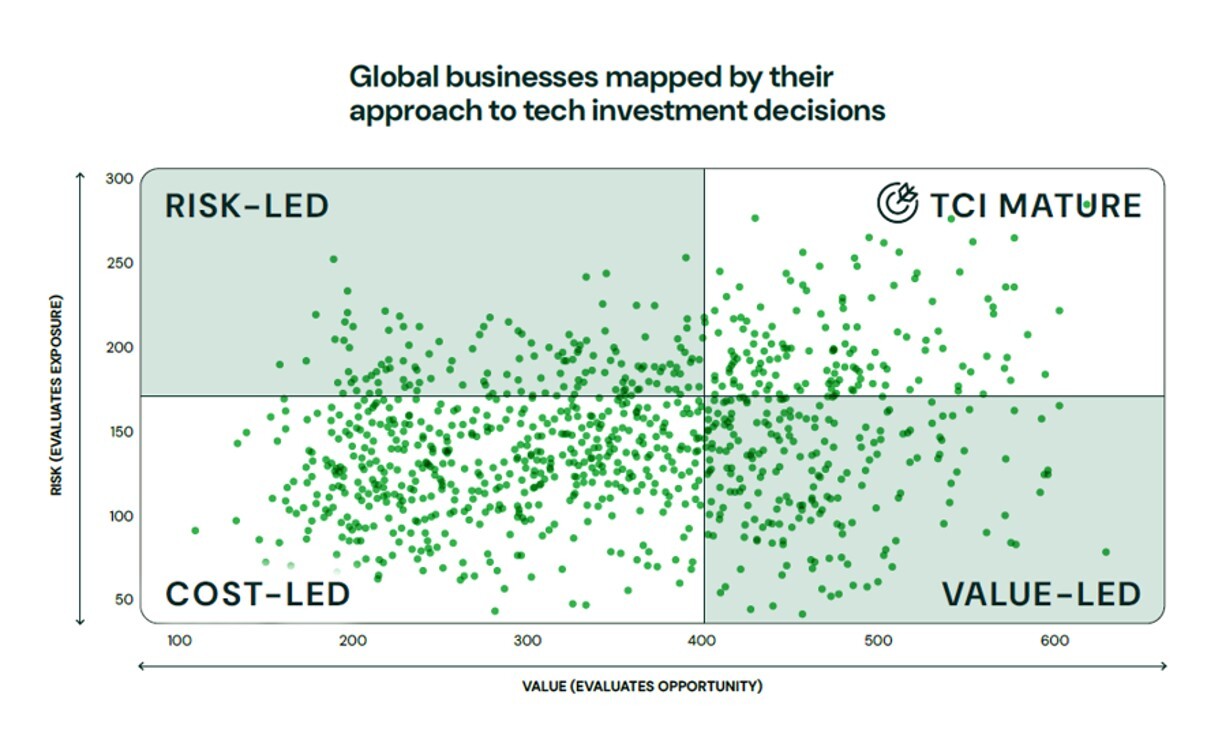
Your assessment places you in the Cost-led quadrant. This means that technology investment decisions in your organization are primarily driven by short term financial metrics.
This approach embeds discipline and control, but it can also limit visibility into the longer term costs, risks, and value that emerge over the technology lifecycle.
Organizations in this quadrant often underestimate risks that are harder to see at the point of purchase, such as failure to meet compliance requirements or recover value at end-of-life.
To move toward greater TCI maturity, consider:
-
Expanding investment criteria beyond purchase price to include lifecycle value and risk.
-
Embedding security, compliance, and resilience considerations at the point of procurement.
-
Planning technology refresh, retirement, and value recovery as deliberately as acquisition.
This shift lays the foundation for more resilient, future-ready investment decisions.
The TCI maturity graph shows market trends based on survey data. Your personalized TCI maturity score is indicative only, and it reflects your organization’s position, based on a condensed set of inputs from the research.
2. Risk-led
Congratulations! You’ve taken the first step toward optimizing the value your technology creates across its lifecycle. After all, you cannot manage what you cannot measure.
Your assessment places you in the Risk-led quadrant. This means your organization recognizes the security, compliance, and operational risks that technology introduces, and these considerations strongly influence decision-making.
Understanding risk is essential to managing impact over time. However, it must be proactively identified and addressed when investments are made, while also capturing opportunities to create and recover value.
To move toward greater TCI maturity, consider:
- Shifting from reactive risk management to proactive, lifecycle-based planning
- Embedding security, compliance, and resilience considerations at the point of procurement
- Planning technology refresh, retirement, and value recovery as deliberately as acquisition
This shift lays the foundation for more resilient, future-ready investment decisions.
The TCI maturity graph shows market trends based on survey data. Your personalized TCI maturity score is indicative only, and it reflects your organization’s position, based on a condensed set of inputs from the research.
3. Value-led
Congratulations! You’ve taken another step toward optimizing the value your technology creates across its lifecycle. After all, you cannot manage what you cannot measure.
Your assessment places you in the Value- led quadrant. This means you’re already thinking beyond cost, and this puts you ahead of the curve. The opportunity now is to make tech decision-making more systematic.
Your organization understands that technology creates value - in efficiency, employee performance, and competitive advantage. However, it isn’t always measured consistently across the lifecycle or weighed against the costs and risks that emerge from procurement through end-of-life.
To move toward full TCI maturity, consider:
- Creating a shared, organization-wide definition of technology value and risk
- Ensuring lifecycle-based approach is the default across all technology categories
- Planning technology refresh, retirement, and value recovery as deliberately as acquisition
This shift lays the foundation for more resilient, future-ready investment decisions.
The TCI maturity graph shows market trends based on survey data. Your personalized TCI maturity score is indicative only, and it reflects your organization’s position, based on a condensed set of inputs from the research.
4. TCI mature
Congratulations! You’ve taken another step toward optimizing the value your technology creates across its lifecycle. After all, you cannot manage what you cannot measure.
Your assessment places you in the TCI mature quadrant. You are leading the way in impact-led technology decision-making and you’re well positioned to turn technology investment into long-term advantage.
Your organization understands that technology creates financial, operational, security, and environmental impact across its entire lifecycle, and you actively factor this into decision-making.
Your teams are accountable and understand that technology is developing an unprecedented pace. They need tools to ensure they can continue to maximize technology value and minimize waste as the operating environment changes.
To continue advancing TCI maturity, consider:
- Scaling the TCI approach consistently across all technology categories
- Leveraging circular and managed service models to maximize value and reduce risk
- Working with suppliers and partners to ensure they deliver impact-led solutions
This is where Total Cost of Impact becomes a strategic advantage, enabling resilience, sustainability, and measurable long-term value creation.
The TCI maturity graph shows market trends based on survey data. Your personalized TCI maturity score is indicative only, and it reflects your organization’s position, based on a condensed set of inputs from the research.
Understand the technology impact
Technology creates financial, operational, security, and environmental impacts from procurement to retirement and beyond. TCI brings these consequences and trade-offs into view from day one.

Financial
impact
Evaluates the financial and strategic impact of procurement and investment decisions.
Understand the impact
Operational
impact
Measures efficiency and productivity, ensuring tech streamlines workflows, improves integration and reduces downtime.
Understand the impact
Security &
compliance impact
Assesses data security and compliance, with a lifecycle-view of risk during use and in retirement.
Understand the impact
Environmental
& Social impact
Highlights the impact of tech on people and planet. From energy, waste, and responsible sourcing to user experience and digital inclusion.
Understand the impact
Want to explore more?